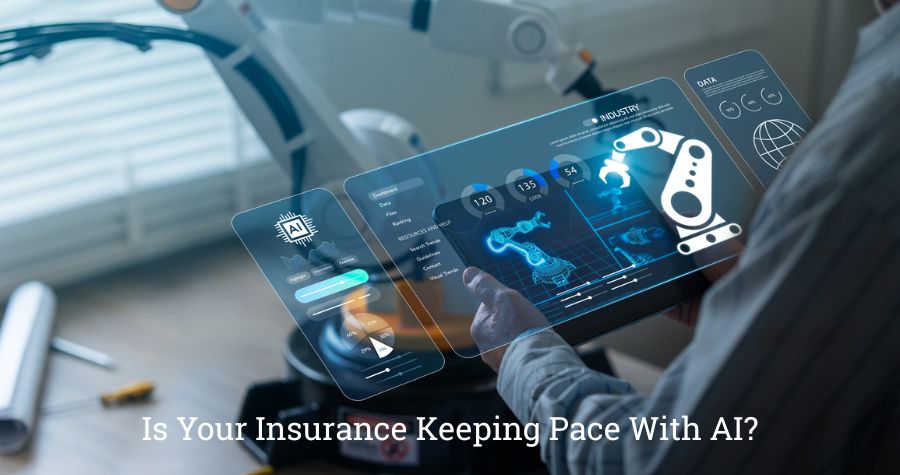
Artificial intelligence is no longer something businesses are planning to adopt in the future, it’s a business risk that your insurance needs to cover. Your business needs to evaluate its AI business risk now.
AI is already embedded into day-to-day operations.
Employees are using AI to prepare reports, write marketing content, analyse data, assist with customer communications and improve productivity. Increasingly, AI is also supporting operational decisions across manufacturing, construction, logistics and professional services.
For many organisations, this has happened organically – with little formal governance or consideration of how AI changes their overall risk profile.
That’s why AI has become a business risk issue rather than simply an IT issue.
The technology itself isn’t inherently risky. The challenge is ensuring that governance, contracts, cyber security and insurance evolve alongside it.
Research from the British Chambers of Commerce suggests AI adoption among UK businesses is accelerating rapidly, while governance and internal controls are struggling to keep pace.
AI creates different risks for different industries
One of the biggest misconceptions is that AI creates the same risks for every business.
In reality, the insurance implications depend entirely on how AI is being used.
Construction
Construction businesses are increasingly using AI to assist with estimating, bid preparation, project planning and document management.
While these tools improve efficiency, businesses should consider what happens if AI-generated specifications, quantities or documentation contain errors that contribute to contractual disputes or professional negligence claims.
Professional Indemnity insurance and robust review procedures become increasingly important where AI assists decision-making.
Manufacturing
Manufacturers are beginning to use AI to optimise production schedules, quality control and predictive maintenance.
While these technologies can improve efficiency, businesses should also consider product liability, machinery breakdown and business interruption risks if automated systems make incorrect recommendations or contribute to operational failures.
Accurate Business Interruption values and Machinery Breakdown cover become increasingly important as production becomes more technology-dependent.
Haulage & Logistics
The transport and logistics sector is rapidly adopting AI for route optimisation, fleet management and predictive maintenance.
As more operational systems become digitally connected, businesses should consider the cyber implications alongside traditional fleet and Goods in Transit risks.
An AI-enabled business is often a more connected business – and greater connectivity can increase cyber exposure.
Professional Services
Perhaps the biggest insurance implications exist for businesses whose advice forms part of the service they provide.
Whether producing reports, financial analysis, legal documents or consultancy recommendations, AI should support professional judgement – not replace it.
Businesses should review whether their Professional Indemnity insurance reflects how advice is now being created and delivered.
Insurance isn’t the only consideration
Insurance forms one part of effective AI risk management.
Businesses should also consider:
- Do we have an AI policy?
- Which platforms are approved for business use?
- Can confidential client information be uploaded?
- Who reviews AI-generated content?
- Do supplier and customer contracts reflect our use of AI?
- Are directors comfortable with the governance arrangements?