
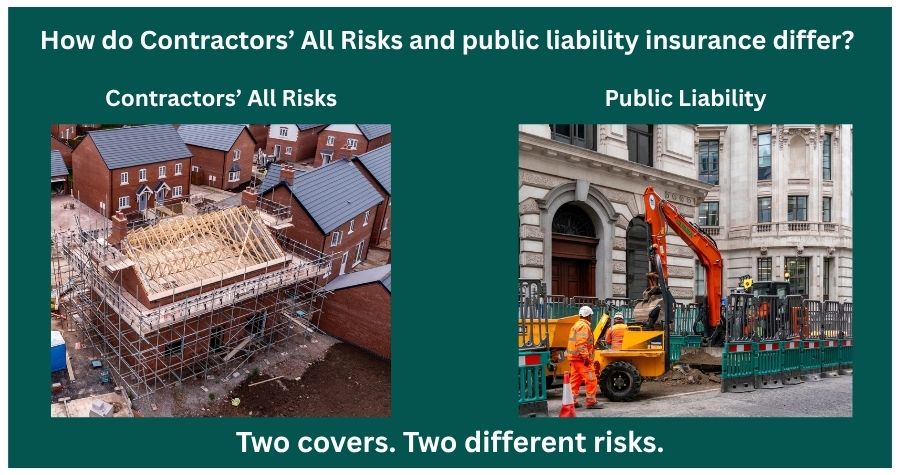
Contractors’ All Risks insurance covers accidental loss or damage to construction works and materials during a project, with optional cover for plant and equipment. Public liability insurance covers a contractor’s legal liability if their work causes injury to another person or damage to third-party property. In simple terms, Contractors’ All Risks protects the project itself, while public liability protects the contractor against third-party claims. The exact cover depends on the individual policy wording.
Contractors’ All Risks and public liability insurance are both important forms of protection for construction businesses, but they are designed to cover different types of loss.
A further dive and the simplest distinction is this:
Contractors’ All Risks insurance protects the construction work and other insured property, while public liability insurance protects the contractor against certain claims made by third parties.
The exact protection will always depend on the policy wording, the sections selected and the individual project.
What does Contractors’ All Risks insurance cover?
Contractors’ All Risks insurance – often shortened to CAR – is a form of construction insurance intended to protect work on a specific project while it’s in progress.
Its contract works section may cover accidental physical loss or damage to:
- The permanent and temporary works being constructed
- Materials intended for incorporation into the project
- Work that has already been completed as part of the contract
- Other insured project property specified in the policy
Depending on the arrangement, cover may also be available for owned plant, hired-in plant, tools and associated construction risks.
For example, imagine that a contractor is building an extension and a fire damages part of the unfinished structure and materials stored on site. Subject to the cause of the damage and the policy terms, the contract works cover may meet the cost of repairing or reinstating the damaged work.
Without appropriate contract works insurance, the contractor or employer could face the cost of completing the same work twice.
Despite the name, “all risks” does not mean that every possible event is insured. Policies contain conditions, limits and exclusions, so the wording must be checked carefully.
What does public liability insurance cover?
Public liability insurance is concerned with the contractor’s legal liability to other people.
It is designed to respond when construction activities cause accidental injury to a third party or accidental damage to property belonging to someone else, subject to the policy terms.
Examples could include:
- A member of the public being injured after entering an inadequately secured working area
- Debris from a site damaging a neighbouring vehicle
- Construction activity causing accidental damage to an adjoining property
- A client or visitor being injured because of the contractor’s work
Public liability insurance may cover compensation and associated legal defence costs where the contractor is legally liable.
It does not ordinarily replace contract works insurance. Damage to the work being constructed can be treated differently from damage caused to third-party property.
A simple example:
Consider a contractor working on a commercial property.
During the project, heavy rain enters the site following accidental damage to temporary protection and damages part of the unfinished work. That loss may fall under the contract works section of a Contractors’ All Risks policy.
If water from the same incident also damages stock belonging to a neighbouring business, the resulting third-party claim may involve the public liability section.
The circumstances, cause of the loss, contractual responsibilities and individual policy wording would determine whether either claim was covered.
Does Contractors’ All Risks automatically include public liability?
Not necessarily.
The term “Contractors’ All Risks” is sometimes used specifically for contract works and plant cover. It can also describe a broader construction insurance package containing several sections, potentially including public liability.
Businesses should not assume that public liability, plant, tools or any other protection is automatically included simply because their documents refer to Contractors’ All Risks insurance.
The policy schedule should clearly identify the sections selected, sums insured, limits of indemnity, excesses and principal exclusions.
What should a construction business check?
Before beginning a project, contractors should consider the following and have and have a clear discussion with their insurance broker:
- Who is responsible for insuring the works under the contract?
- Does the policy cover the full reinstatement value of the project?
- Are the employer and contractor required to be insured jointly?
- Are existing structures included or separately insured?
- Are temporary works and materials away from the site covered?
- Is owned or hired-in plant included?
- Is the public liability limit appropriate for the project?
- Are there restrictions involving height, depth, heat work or particular trades?
- Do subcontractor arrangements meet the insurer’s requirements?
- Is cover required during the maintenance or defects-liability period?
Employers’ liability, professional indemnity, environmental liability and other covers may also need to be considered. Neither public liability nor contract works insurance should be treated as a complete construction insurance programme on its own.
How Readhunt can help
Construction risks are rarely identical. The appropriate insurance will depend on the work undertaken, contract values, contractual responsibilities, project locations, use of subcontractors, plant exposure and claims history.
Readhunt works with construction businesses to understand these details and arrange insurance around their actual activities.
If you are unsure whether your current policy adequately covers both your contract works and third-party liabilities, speak to our team about a review.
Cover is subject to the individual policy wording, schedule, limits, conditions and exclusions.